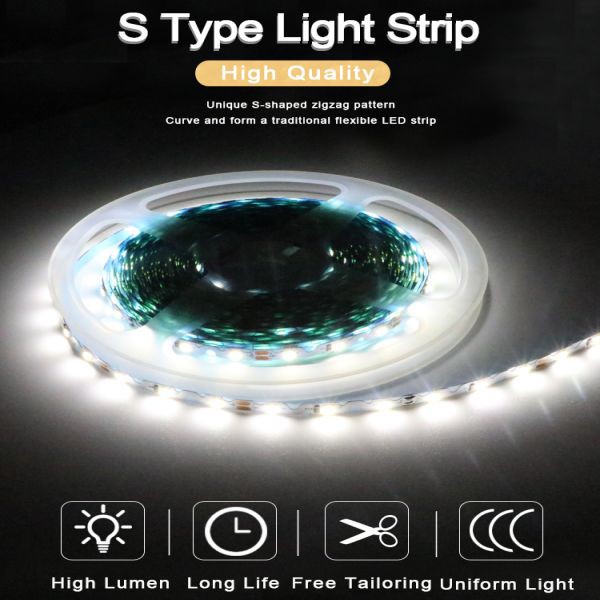
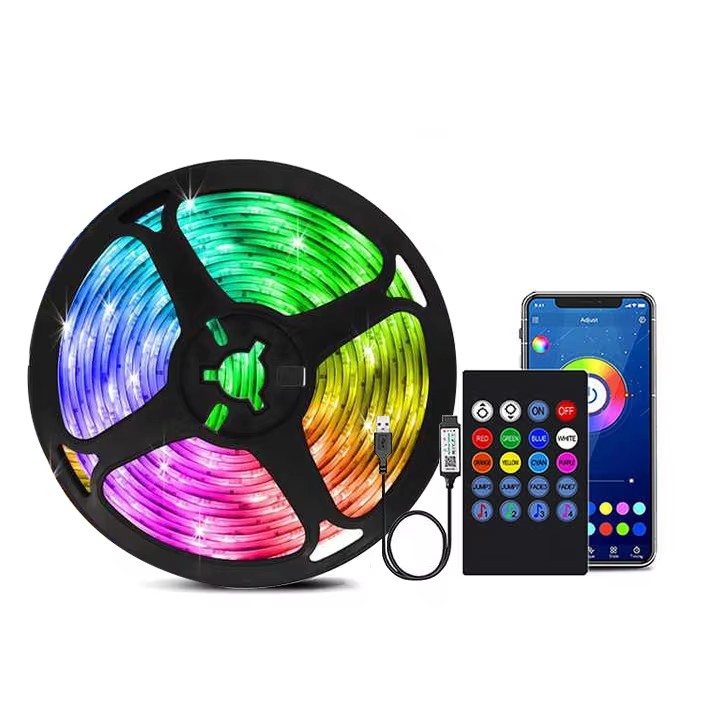
The selection guide of LED light strip is as follows:
1. Chips used in LED light band: chips include domestic and Taiwan chips, as well as imported chips (including American chips, Japanese chips, German chips, etc.). Different chips have different prices. The most expensive chip in the market is American chip, followed by Japanese chip and German chip, and the moderate price is Taiwan chip. What chip is used? What effect should be achieved? Know well before purchasing.
2. LED packaging: resin packaging and silicone packaging. The price of resin packaging is cheaper, because the heat dissipation performance is slightly poor, and everything else is the same. The heat dissipation performance of silicone packaging is good, so the price is slightly higher than that of resin packaging.
3. Consistency of LED color: there are many packaging factories in China, and there are thousands of them, large and small. Of course, there are strengths and weaknesses. There are many small packaging plants that do not have light and color separation machines, so they either do not separate light and color, or send them out, which is difficult to guarantee the quality. The color consistency of LED without light and color separation is poor, and the effect is not so good when it is installed on the LED light strip, of course, the price difference is relatively large.
4. Led welding effect: there are two kinds of LED light strip assembly, manual welding and machine welding. Manual welding is to use a soldering iron and use the most primitive method to weld. The amount of solder at the solder joint is uneven, and most of it is a dot covering the solder foot. At the same time, there will be different degrees of tin tips, which is a typical phenomenon of manual welding. The products produced by this operation method are unsightly in appearance (inconsistent solder joint size, excessive flux residue, unsmooth solder joint, burned LED package, etc.), and poor electrostatic protection measures. Many LED chips are punctured, resulting in slight or no light when powered on. Machine welding is different. It is produced by SMT patch process, solder paste and reflow process. Therefore, the solder joints on the LED lamp belt are relatively smooth and the amount of solder is not much. The solder joints extend from the FPC pad to the LED electrode in an arc shape, which not only makes the product look beautiful after welding (the solder joint size is consistent, the solder joint is smooth, there is no solder residue, and the LED package is intact), but also does not show the phenomenon that the chip is burned by static electricity. At the same time, the position and direction of the LED are beautiful. This can be seen directly from the appearance.
5. FPC material: FPC is divided into calendered copper and copper clad. Copper clad plate is cheaper and calendered copper is more expensive. The bonding pad of copper clad plate is easy to fall off when bending, while the calendered copper will not. The specific material of FPC depends on the purchaser's own decision according to the use environment.
6. Has FPC passed environmental protection certification and UL certification? Whether the LED has patents, etc. Some are certified and patented, which are more expensive, while others are cheaper.
7. Brightness of LED: the price of LED with different brightness is different, and the price difference between ordinary brightness and bright LED is quite wide. Therefore, when purchasing, you must clearly know what kind of brightness you need, so as to accurately position your products.
8. LED color: different colors, different prices. The price of white and green is higher than that of other colors due to the difficulty of color matching and light and color separation; Red, yellow, blue and other colors are easier to separate light and color, and the consistency is better, so the price is slightly cheaper. Special colors such as purple and Brown are the most expensive due to color matching.
9. Led size: LED with different specifications and sizes has different prices. For example, the prices of 0603 led and 1210 (i.e. 3528) led are quite different; The price difference between 1210 and 5050 LED is another step.
10. Look at the cleanliness of the surface of the LED light strip. If the LED light strip produced by SMT process is used, its surface cleanliness is very good, and no impurities and stains can be seen. However, if the fake LED light strip produced by hand welding process is used, no matter how the surface is cleaned, there will be stains and traces of cleaning, and there will be flux and tin residue on the surface of FPC.
11. Look at the packaging. The regular LED light strip will be packaged with anti-static reels, usually 5 meters or 10 meters, and then sealed with anti-static moisture-proof packaging bags outside. The fake LED light belt will use recycled reels because of cost savings, and then there is no anti-static and moisture-proof packaging bag. A careful look at the reels can see that there are traces and scratches left when removing labels on the surface.
12. Look at the label. There will be printed labels on the packaging bags and reels of regular LED lights, instead of printed labels. The labels of the fake version are printed, and the specifications and parameters are not unified.
13. See the attachment. The regular LED light belt will be attached with the instructions and specifications of the light belt in the packaging box, and will also be equipped with LED light belt connector or card holder; The fake LED light belt packaging box does not have these accessories, because some manufacturers can still save after all.